“We’re all set. We did our estate plan years ago.” Whenever I hear those words, I know it may be time to open the binder. Sometimes the binder is beautiful: leatherette cover, gold lettering, tabs, enough tabs to suggest that no further human intervention will ever be required. Then we start looking under the hood.
They signed the trust in 2008. The house they bought in 2016 is still in their individual names. The successor trustee is now 81 and lives three states away. The children described as young beneficiaries are pushing 40. Somewhere, attached to a retirement account, is a beneficiary designation naming somebody nobody has thought about since Friends was producing new episodes. The trust itself is doing wonderfully. Unfortunately, life moved on without it. After years of estate planning, probate, trust administration and conservatorship work, I have found that the dangerous estate plan is not always the one that does not exist. Sometimes it’s the one everyone is certain is fine.
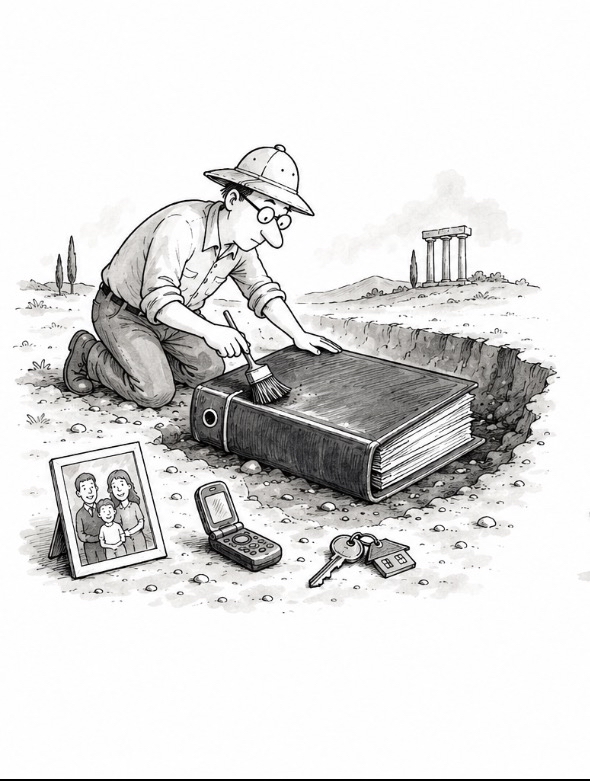
Excavating an estate plan
Does Your Trust Actually Own Your Property?
Creating a revocable living trust and funding one are two different things. Signing the trust creates the vehicle; you still have to put something in it. Consider a hypothetical couple. We’ll call them Bob and Carol, because Bob and Carol have been through enough already. They created a living trust years ago, signed everything, put the documents in a binder, and told the children they had “taken care of all that.” And they had. Sort of.
Years later, they sold the house originally transferred to the trust and bought another one. They titled the new house in their own names. They opened an investment account and never moved it into the trust. Eventually, they closed the trust’s old bank account too. By the time anyone looks closely, the trust is in pristine condition. It just doesn’t own much. That matters because signing a trust doesn’t automatically transfer property into it. Funding may require deeds, changes in account ownership, assignments of business interests, or coordination of beneficiary designations, and not every asset gets handled the same way. You generally don’t retitle a retirement account into a trust while you’re alive; it passes through its own beneficiary form instead, the kind of detail that gets lost in a filing cabinet for twenty years. A trust is not magic. It is more like a garage: building one doesn’t automatically put your car inside.
Who Is Really the Beneficiary of Your Retirement Account?
This one can hurt. Imagine Larry. Larry spends considerable time creating a thoughtful estate plan. His trust carefully describes what should happen to his property. He updates it after his children are born, and again after a divorce. Everything appears beautifully coordinated. Except for one piece of paper.
In 1998, Larry filled out the beneficiary form for his retirement account and named Susan, the woman he was dating at the time. Larry and Susan eventually went their separate ways. Larry married. Divorced. Raised children. Bought property. Created a trust. Lived another quarter century. The beneficiary form kept quietly doing its job. When Larry dies, everyone discovers Susan. Susan hasn’t spoken to Larry since the Clinton administration. The retirement custodian, however, is interested in the beneficiary designation, not the family history. Retirement accounts, life insurance, payable-on-death accounts, transfer-on-death accounts, and jointly owned property can all pass outside the distribution provisions of a will or trust. Beneficiary designations and ownership need to line up with the rest of the plan, not just sit next to it. Sometimes the most consequential document in a 70-page estate plan is the one-page form somebody filled out 25 years ago.
Can an Estate Plan Help Avoid a Conservatorship?
Estate planning isn’t only about what happens when you die. Often the more immediate question is what happens when you’re alive but unable to manage your own affairs. I’ve spent a substantial part of my career dealing with conservatorships and probate court here in Los Angeles, and one purpose of estate planning is to reduce the chances a family ends up sorting these questions out there. Imagine Dad suffers a serious stroke on Tuesday. By Friday, someone needs to pay his bills, deal with the bank, manage investments, talk to insurance companies, and make healthcare decisions. His three children love him very much. Unfortunately, they also disagree about virtually everything.
Nobody has clear authority. The bank won’t take instructions simply because somebody announces, “I’m his daughter.” The investment custodian has rules. The doctors have rules. Everybody has rules. The family discovers something unpleasant: love and legal authority are not the same thing. A durable power of attorney can hand someone authority over your financial matters. Healthcare documents can name who makes medical decisions when you can’t. A properly funded revocable trust lets a successor trustee step in and manage trust assets if you become incapacitated. Skip all of that, and a judge ends up making these calls instead of your family. The courthouse is a particularly expensive place to discover who everyone thinks should be in charge.
Is the Person You Named 15 Years Ago Still the Right Person?
Estate planning documents have an unfortunate habit of preserving people in amber. Your brother was 52 when you named him successor trustee. He lived ten minutes away, ran a successful business, and organized family vacations using spreadsheets. Excellent choice. Fifteen years later, he’s 67, lives in Arizona, has health problems, and has trouble remembering his online banking password. He may still be a wonderful brother. He may no longer be a wonderful trustee.
The same question applies to executors, agents under powers of attorney, healthcare decision-makers, and guardians nominated for minor children. These are not honorary positions. A trustee or agent may eventually be responsible for substantial assets, tax returns, investment decisions, property, difficult beneficiaries, and family disputes, and judgment, temperament, and organization all matter. People change. The person you trusted in 2009 may still be the right person. It’s worth checking.
Has Your Estate Plan Become an Archaeological Site?
Pull a 20-year-old estate plan from a filing cabinet and sometimes you’re looking at the remains of an extinct civilization. There is the former spouse. There is the house sold in 2011. There is the brother-in-law nobody speaks to anymore. There are elaborate restrictions protecting the inheritance of a “young child” who is now a 38-year-old CPA with two children of her own. Meanwhile, someone who wasn’t even alive when the documents were signed may now be one of the most important people in the family.
An estate plan can remain legally operative while becoming practically obsolete. A wedding, a divorce, a death in the family, a move across state lines: any one of those is reason enough to open the binder again, and so is a change in your beneficiaries. Someone who needed heavy protection fifteen years ago may be perfectly capable of managing an inheritance today. The old documents may still be valid. That doesn’t mean you’d write them the same way today.
What Happens If You Never Create an Estate Plan?
There is, of course, another approach: no binder, no trust, no powers of attorney, nothing. California has a plan for that too. If you die without an effective estate plan, California’s intestate succession law decides who gets what. It runs off a chart of family relationships written into the statute books, not off anything you actually wanted.
The problem is that the Probate Code never met your family. It doesn’t know that one child has spent the last decade helping you while another disappeared. It doesn’t know that you consider a stepchild your own. It doesn’t know about the friend who became family, or the charity that mattered to you. Nor can it sit down with you and ask who should manage things if you become incapacitated. Doing nothing is still a form of estate planning. It just means accepting the default settings.
What About Online Estate Planning Forms?
There is nothing inherently sinister about a legal form. Lawyers use forms too. The problem is confusing the document with the planning. You can order a box of perfectly good engine parts online. That doesn’t tell you whether those parts belong in your engine, whether they were installed correctly, or whether the car will start when you turn the key. Estate planning has the same problem.
A document can name a trustee, but it can’t decide whether your brother is actually a good one. It can create a trust, but it can’t make you transfer the house into it. It can say who receives your estate, but it can’t make the forgotten retirement beneficiary form agree. And a document you signed in 2012 has no idea what happened to your family in 2026. Generic forms also tend to miss the particular mix of real estate, retirement accounts, businesses, beneficiaries, tax concerns, and family circumstances that make your estate yours. The form was never the problem. The assumption that it finished the job is.
The Estate Plan You Have
People tend to think estate planning is about deciding who gets the house. That’s part of it, but the questions that cause trouble are often more mundane: Who takes care of things if you can’t? Who has authority? Does that person know what to do? Are the assets actually connected to the plan? Do the beneficiary forms agree with the trust? And when someone finally opens that beautiful binder, will it describe the family that exists now, or the family that existed 20 years ago?
An estate plan is less a stack of documents than a collection of moving parts. The documents, assets, beneficiary designations, and people all need to point in roughly the same direction, which leads to a better question than “Do I have a trust?” Try this instead: “If something happened tomorrow, would the estate plan I think I have actually work?” Sometimes the answer is yes. Sometimes it’s time to open the binder. If you’d like a second pair of eyes on yours, that’s exactly the conversation we have with clients at Schomer Estate & Wealth Advisors, in Los Angeles, every week. https://www.schomerlawgroup.com/services/los-angeles-california-estate-planning-2/
We also run free seminars for anyone who’d rather sit in and listen before deciding anything. Either way, give us a call at (310) 337-7696, and let’s find out which kind of binder you actually have. https://trustprof.substack.com/

- The Estate Plan You Think You Have - August 20, 2026
- How a No Contest Clause Can Help Your California Estate Avoid Probate Litigation - August 17, 2026
- Reasons to Incorporate a Living Trust into My California Estate Plan - August 16, 2026